

Onboard air system for panel beaters: Choose Right 2026
Panel beaters’ onboard air systems are vehicle-mounted compressed-air setups intended to support mobile inflation and suitable pneumatic tasks away from workshop air lines. This 2026 guide explains how to separate those jobs from continuous workshop demand and choose equipment with application advice from Boss Air Suspension.
- Choose an onboard air system for panel beaters around the actual task, not maximum tank pressure.
- Boss Air Suspension supplies onboard air equipment with technical advice for vehicle-based applications.
- Match compressor airflow, duty cycle and electrical demand before selecting an aluminium air tank.
- Keep continuous sanding, spray painting and breathing-air requirements separate from general vehicle-mounted compressed air.
Why onboard air matters for panel beaters and repair shops
A repair workshop and a mobile service vehicle have different compressed-air requirements. A vehicle-mounted system puts air near the job, but its usefulness depends on how much air the task consumes and how long the compressor can run under the specified conditions.
Tyre inflation and air suspension adjustment are different duties from sustained sanding or spraying. Do not treat an onboard compressor as a replacement for workshop compressed air without checking the complete operating requirements.
Boss Air Suspension supplies onboard air systems and components for tyre inflation, load assist suspension and custom air applications. That range provides a starting point for vehicle-based work; it does not establish that any particular package will run your panel-beating tools.
For your 2026 equipment plan, separate mobile convenience from production capacity. Keep continuous workshop processes on equipment selected for those processes, and assess onboard air against the jobs your service vehicle actually performs.
How to choose an onboard air system for panel beaters
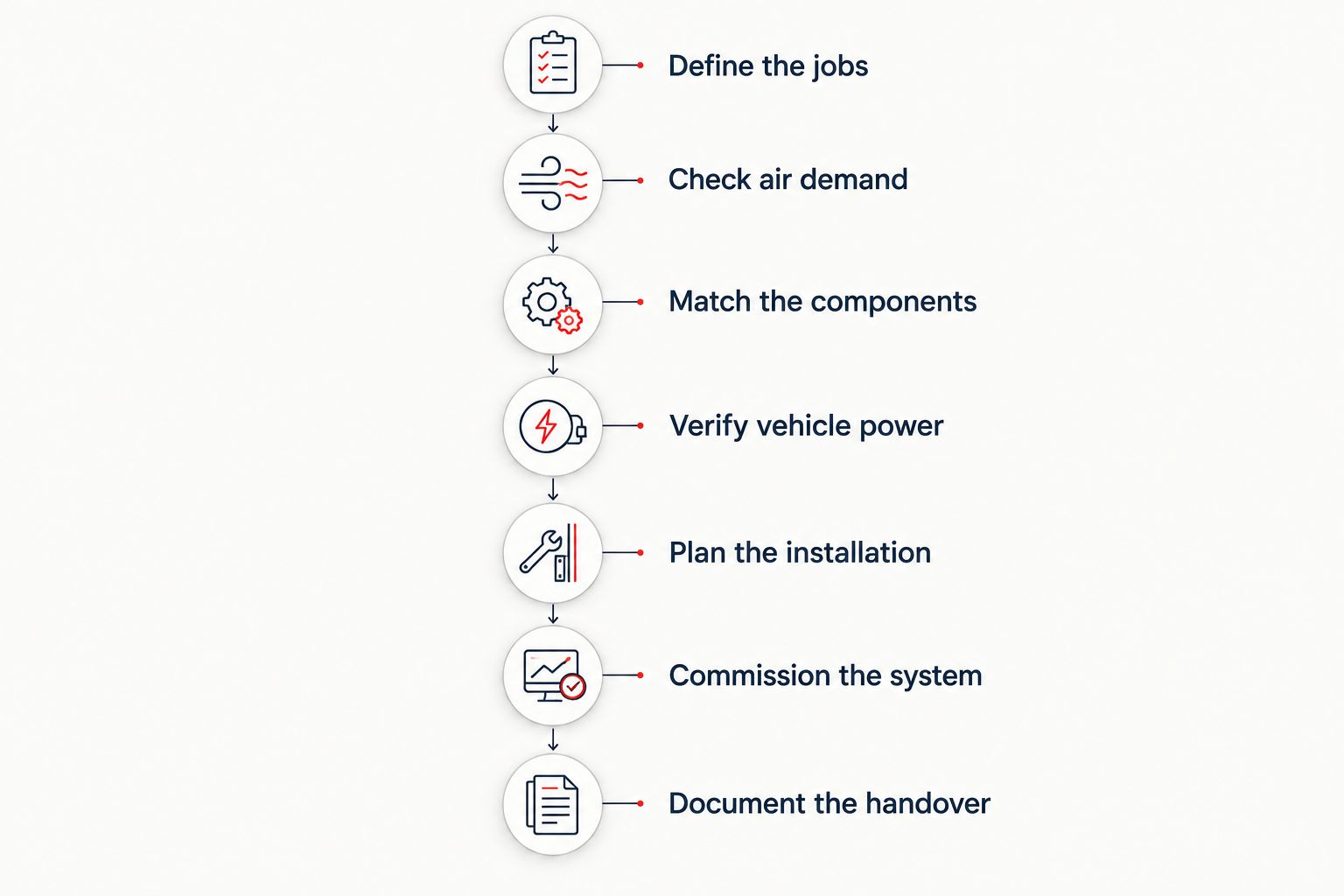
Define the jobs
Start with a written task list rather than a shopping list. Use a notebook or spreadsheet to identify what needs compressed air, where the work happens and whether a workshop hose already reaches the job.
For mobile repairs, separate tyre inflation, vehicle air suspension servicing and occasional pneumatic-tool use. For workshop work, list sustained sanding and painting separately. Their supply and air-quality requirements need their own assessment.
In your 2026 job list, record the actual tool model rather than writing only ‘air tools’. An impact wrench, sander and spray gun do not place the same demand on an air supply. Also record whether technicians will use equipment simultaneously.
This exercise prevents a common purchasing error: choosing a compact system for an occasional task, then expecting it to support an entire repair process.
- List each intended task and the equipment used.
- Mark each task as vehicle-based or workshop-based.
- Identify continuous operation and short bursts separately.
- Record whether multiple outlets will operate together.
- Exclude breathing air from the general onboard-air brief.
Check air demand
Read the tool manual and compressor documentation first. Record required airflow, working pressure and the conditions attached to those figures; free-air delivery and delivery at working pressure are not interchangeable specifications.
Maximum pressure alone does not tell you whether a compressor can keep a tool running. Airflow describes the supply available to the task. Duty cycle describes permitted running time under stated conditions, including any required rest period.
A tank supplies stored air during a burst of demand, but the compressor must replace that air afterwards. A larger tank does not increase the compressor’s sustained delivery. If consumption exceeds supply, pressure falls as the reserve is used.
Check performance with the intended hose, fittings and regulator included. Restrictions and pressure loss can make a system behave differently at the outlet than at the tank gauge.
- Obtain each tool’s airflow and pressure requirements.
- Compare compressor delivery at the required operating pressure.
- Check the duty-cycle definition and operating conditions.
- Allow for simultaneous demand where applicable.
- Confirm acceptable pressure at the working outlet.
Match the components
Sketch a basic layout yourself before requesting a package recommendation. Include the compressor, tank where required, pressure control, pressure relief, gauge, drain, outlets and any task-specific air treatment.
Boss Air Suspension is best suited to repairers sourcing vehicle-mounted air equipment with application advice. Its compressor, tank, controller and fitting ranges help you assemble an application-specific system, but component selection still depends on the job requirements you have recorded.
The catalogued 9 litre bare aluminium air tank is an air-storage component, not a complete working system. The bare version leaves fittings and plumbing to be selected separately. Tank capacity alone does not establish tool suitability.
A compact tank suits a different mounting envelope from a larger tank. Measure the available space and check rated pressure, port requirements, mounting instructions and access before choosing storage capacity.
- Match all components to the intended operating pressure.
- Select tank capacity against space and burst demand.
- Confirm compatible threads, fittings and air-line specifications.
- Include suitable pressure relief and pressure control.
- Keep drain and service points accessible.


Verify vehicle power
Check the vehicle’s electrical system and the compressor’s requirements before planning the installation. Boss supplies both 12V and 24V compressors; the voltage must match the selected equipment and approved wiring arrangement.
Use the vehicle documentation and compressor instructions to establish current demand, cable sizing, protection and switching requirements. Do not choose cable by appearance or reuse an accessory circuit without checking its capacity.
A system operating with the engine stopped draws on the available battery supply. Assess that operating pattern separately from use with the engine running, and retain adequate starting capability through an appropriate electrical design.
Collision repair creates another consideration: inspect the proposed mounting and cable route for existing damage. An air installation should not conceal damaged wiring or interfere with vehicle safety systems. Have a qualified installer address electrical integration where required.
- Confirm whether the vehicle supply is 12V or 24V.
- Check compressor current draw and installation instructions.
- Specify suitable cable, circuit protection and switching.
- Assess battery and charging capacity for intended use.
- Keep wiring clear of heat, movement and damaged areas.
Plan the installation
Measure the vehicle and draw the proposed layout before drilling or ordering brackets. Check component dimensions, service clearance and the effect on existing equipment, including trays, canopies and underbody accessories.
An accessible air outlet is useful, but it should not create a snag point or expose a hose to sharp edges. Position the compressor according to its ventilation and environmental requirements, not simply wherever spare space appears.
Allow access to the tank drain, electrical protection and pressure-control components. A concealed fitting that cannot be inspected turns a small leak into a difficult repair. Avoid mounting arrangements that require removing unrelated equipment for routine service.
Adding onboard equipment also adds vehicle mass. Include the installation in your loaded-vehicle assessment, especially where a service ute already carries tools and parts. Air suspension support does not increase legal payload, GVM or towing capacity.
- Measure the mounting envelope and service clearances.
- Follow approved mounting instructions for each component.
- Route air lines clear of heat, abrasion and movement.
- Position outlets where hoses can connect without strain.
- Include installed equipment in vehicle weight checks.
Commission the system
Test the complete installation against the written job list, not just whether the compressor switches on. Use the manufacturer’s commissioning procedure and suitable gauges to check operation within the specified limits.
Verify pressure-control operation, inspect joints for leaks using an approved method and check the outlet under representative demand. Record recovery behaviour and any required cooling pauses. Do not defeat a pressure switch or thermal protection to finish a test.
Moisture management matters because compressed air can carry water into the tank and downstream equipment. A water trap is one part of air treatment; it does not automatically establish suitability for spray painting or breathing air.
Keep sanding dust under the workshop’s extraction and exposure-control procedures. Compressed air is not a substitute for dust extraction, and it should never be directed at skin or used to clean clothing.
- Check pressure control and relief-device requirements.
- Inspect fittings and lines for leaks.
- Test outlet performance during the intended task.
- Confirm drainage and task-specific air treatment.
- Record operating limits and safe-use instructions.
Document the handover
Create a short operating sheet once commissioning is complete. Include the installed components, permitted uses, pressure settings, maintenance instructions and the procedure for isolating electrical and stored-air energy before servicing.
For your 2026 handover record, identify the installation date and the documentation supplied with each component. Keep commissioning results with the service vehicle’s maintenance records so another technician can understand the system without tracing every line.
Set inspection and drainage intervals from the equipment instructions and actual operating conditions. Do not invent a universal schedule for vehicles that work in different environments or use compressed air at different rates.
Give the operator a clear fault rule: stop using the system if it leaks, overheats, has damaged wiring or fails to control pressure correctly. Arrange diagnosis rather than repeated resets. Confirm warranty terms for the actual components purchased instead of assuming one warranty covers the entire installation.
- Record component identities and operating limits.
- Keep wiring and plumbing layouts with vehicle records.
- Document isolation and depressurisation procedures.
- Set maintenance tasks from manufacturer instructions.
- Explain fault reporting and service arrangements.
The selection sequence is deliberate: define the task before choosing components, then verify power and installation before testing the finished system.
Compare air-supply options for repair work
Choose the air supply by location, duration and air-quality requirements. No single arrangement suits every repair task, and a convenient mobile outlet does not establish production-tool capability.
| Option | Best for | Practical advantage | Key limitation |
|---|---|---|---|
| Workshop compressed-air supply | Fixed repair bays and sustained tool use | Can be specified around workshop-wide demand | Does not provide air away from the installed distribution system |
| Portable vehicle compressor | Occasional mobile tyre inflation | Can move between vehicles without a permanent fit-out | Tool suitability depends on verified airflow and duty cycle |
| Permanently mounted compressor | Regular vehicle-based inflation or compatible pneumatic tasks | Keeps the air source installed in the service vehicle | Needs suitable wiring, mounting and operating access |
| Compressor with aluminium air tank | Applications needing a stored-air reserve | Makes stored air available for short demand bursts | Reserve capacity does not increase sustained compressor output |
| Dedicated painting air supply | Spray processes requiring controlled air quality | Can be specified around the spray equipment’s requirements | Needs process-specific capacity, filtration and moisture control |
Use this comparison to narrow the arrangement, then assess individual components. If a supplier cannot confirm delivery at the required working pressure, do not infer it from tank capacity or maximum pressure.
Common mistakes panel beaters and repair shops make
Treating inflation equipment as production equipment
A compressor selected for tyre inflation has not automatically been selected for sustained sanding. Check the actual tool demand and compressor operating limits before assigning it a workshop production task.
Buying storage before checking supply
A tank provides a reserve, but it cannot correct insufficient sustained airflow. Choose the compressor around demand first, then select storage around the application and available mounting space.
Assuming a water trap makes air paint-ready
Spray equipment needs air quality suited to its process. Check the required filtration, moisture control and contamination limits; do not assume an onboard air package meets them because it includes a water trap.
Overlooking repaired or modified vehicle areas
Previous collision repairs, canopy changes and accessory wiring affect installation planning. Inspect mounting points and routing before fitting equipment, and resolve damaged structures or circuits rather than working around them.
Leaving controls without clear identification
A service vehicle can have separate circuits for tyre inflation and air suspension. Identify outlets and controls clearly, and do not allow a general-purpose hose connection to bypass application-specific pressure control.
FAQ
What is an onboard air system for panel beaters?
An onboard air system for panel beaters is a vehicle-mounted compressed-air setup selected for defined mobile repair or inflation tasks. Its suitability depends on airflow, working pressure, duty cycle, electrical supply and air quality.
Can an onboard compressor run a panel-beating sander?
Only a system verified against the sander’s airflow, pressure and operating-duration requirements should be used. Tank pressure alone does not establish suitability for sustained sanding.
Is a larger air tank better for a repair vehicle?
A larger tank provides more storage, not more sustained compressor delivery. Select capacity around burst demand, mounting space, vehicle mass and compressor recovery requirements.
Should a repair vehicle use a 12V or 24V compressor?
Use the compressor voltage specified for the vehicle’s approved electrical arrangement. Confirm wiring, protection, battery supply and charging capacity against the compressor instructions.
Can I use onboard air for spray painting?
Use onboard air for spraying only after confirming the complete spray process’s capacity and air-quality requirements. A water trap alone does not establish paint-ready air.
Does onboard air increase my service ute’s payload?
No, an onboard air system does not increase legal payload, GVM or towing capacity. Include the installed equipment’s mass when checking vehicle and axle limits.
Can Boss Air Suspension help choose components for a repair vehicle?
Boss Air Suspension supplies onboard air equipment and provides technical advice. Supply the vehicle details, intended tasks and operating requirements so component suitability can be checked.
One last thing
Commission the system at the working outlet, not just at the tank. A tank gauge reading does not show the pressure available through the hose and fittings while equipment is consuming air.
Before signing off your 2026 installation, give Boss Air Suspension the actual task requirements and confirm the proposed components against them. If the job needs continuous workshop air, keep that requirement separate rather than stretching a vehicle-mounted system beyond its documented limits.